
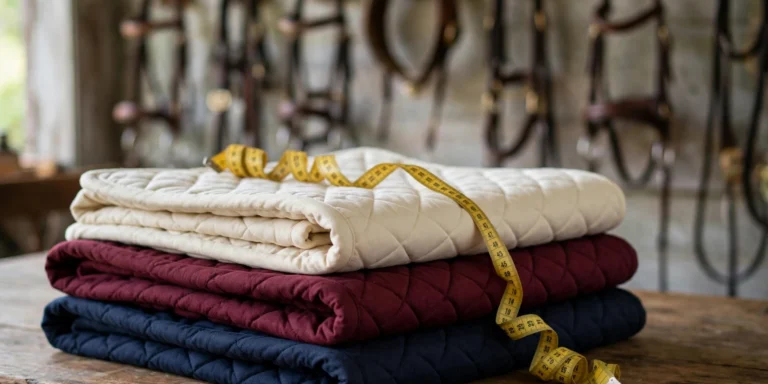
Consider a common scenario: a US distributor emails a spec sheet for a rug program with the size column reading \72.\ The factory, working in centimeters, reads it as 72 cm — roughly a 3\’0\ rug, a pony size — and cuts the bulk run accordingly. The distributor meant 72 inches: a 6\’0\ rug, a full horse size. Nobody wrote the unit. The cartons arrive, the sizes are exactly as specified, and every single one is wrong. The failure was not manufacturing. It was measurement language.
The short answer: Equestrian sizing runs on three systems: the UK trade uses feet and inches for rugs and hands for horse height; the EU trade works in centimeters; pads, girths, and helmets follow per-category conventions. Export specs must name the unit on every figure, carry dual units on consumer sizes, and confirm each brand\’s chart — arithmetic converts, but conventions decide.
This guide is the measurement companion to our numnah vs saddle pad naming guide (boundary: that guide covers what to call the product per market; this one covers how to measure it — the two halves of export localization, written as a pair) and builds on our per-cut saddle pad sizing charts (boundary: that guide gives pad dimensions per cut; this one gives the market-measurement system those dimensions must be expressed in).
Key takeaways
- UK rugs are sized in feet and inches, in 3-inch increments, measured as body length from center of chest to rear of rump — WeatherBeeta\’s published guide is the reference pattern.
- Horse height is quoted in hands (one hand = four inches); size charts convert hands, inches, and centimeters, but every brand\’s chart is its own — no universal standard exists.
- Write the unit on every figure in every spec: a bare \72\ is a defect waiting to happen. Dual-unit consumer sizing (inches + cm) is the export-safe default.
- Pads, girths, and helmets each follow category conventions (per-cut pad charts, inch girths, cm helmets) — confirm the per-product chart, never assume one system\’s logic transfers.
- MOQ 50 pieces per color; size programs multiply SKUs fast, so confirm whether the MOQ counts per colorway across sizes or per colorway per size.
How are horse rugs actually sized in the UK?
Direct answer: UK horse rugs are sized in feet and inches, in 3-inch increments, by body length — measured from the center of the chest to the rump. WeatherBeeta\’s published guide states it plainly: \Horse rugs are measured in feet and inches,\ with the between-sizes rule to choose the bigger size. (WeatherBeeta — Horse Rug Size Guide)
Two measurement methods sit behind the size, and the export spec should name which one it uses. WeatherBeeta\’s guide gives both: the back seam (A), measured from the wither to the top of the tail, and the body length (B), measured from the center of the chest to the end of the rump — with the rug size taken from the body length. The same guide\’s conversion table runs Euro (cm) alongside feet-and-inches and raw inches, which is exactly the dual-unit discipline an export program should copy: one measurement, expressed in every unit the markets read.
The between-sizes rule deserves attention because it is a fitting philosophy, not just arithmetic. WeatherBeeta\’s guide says: if the horse falls between sizes, choose the bigger size — and notes that horses of the same height come in different shapes, so the table is a guide only. For an exporter, that means the size chart is the start of the fitting conversation, not the end: body shape (deep chest, broad shoulders, fine build) moves the answer up or down a size, and the program\’s reorder data — not the chart — is the final authority.
What does \16 hands\ mean on an export spec?
Direct answer: A hand is four inches — the traditional horse-height unit, written \hh\: 16 hands is 64 inches (about 163 cm). Hands describe the horse, not the product — buyer shorthand that every chart converts to the product\’s own units. Horse & Hound\’s glossary confirms: one hand equals four inches. (Horse & Hound — equestrian terms glossary)
Two notation traps catch exporters. First, the decimal: 15.2 hh means 15 hands and 2 inches (62 inches total), not 15.2 hands — the digit after the point is inches, and it only runs 0–3 before rolling into the next hand. Second, the conversion direction: hands-to-inches is trade convention (×4), while inches-to-centimeters is plain arithmetic (×2.54). The convention part is what the market must recognize; the arithmetic part any factory can compute — which is why specs should show both the hands shorthand and the converted figure, never hands alone.
For the spec writer, the rule is: hands may appear in the buyer-facing size story (riders think in hands), but the manufacturing dimension is always an explicit length with its unit. \Fits 15.2–16 hh\ is a merchandising statement; \spine 64 cm, drop 56 cm\ is a manufacturing statement. Confusing the two is how the \72\ carton happens.
Which products stay imperial and which go metric?
Direct answer: It varies by category and market: UK rugs stay in feet and inches, EU rug programs work in centimeters, English girths are quoted in inches, and saddle pads follow per-cut charts with no universal standard. The table below maps the common conventions — each row is the observed trade pattern, not a law, so confirm the per-product chart before quoting.
| Product | Typical US/UK convention | Typical EU convention | Exporter rule — and the conditions |
|---|---|---|---|
| Horse rugs / blankets | Feet and inches, 3-inch increments (WeatherBeeta pattern) | Centimeters, brand\’s own chart | Carry both on every size: the UK trade thinks in 6\’0\, the EU factory cuts in cm. Between-sizes: follow the brand\’s published rule (WeatherBeeta: size up), then correct against sell-through |
| Saddle pads | Per-cut charts (Full / Cob / Pony); dressage vs AP vs jump cuts differ | Same per-cut logic, cm figures | No universal standard exists — our per-cut sizing charts and pony & cob program guide both stress per-maker charts. Quote per the factory\’s measured chart, never from a generic conversion |
| English girths | Inches, in 2-inch increments, measured buckle-end to buckle-end | Centimeters on the same method | The measuring method matters more than the unit: middle-hole targeting and the 2-inch step are the method (see our horse girths guide). Convert the figure, keep the method |
| Western pads | Inches — square-inch sizing (e.g. 32\ × 32\ as one retailer\’s stock size) | cm equivalents per program | Contoured vs straight profiles change the effective coverage at the same nominal size — size and profile travel together |
| Riding helmets | Inches or hat-size in some US retail; cm in EU | Centimeters, per-maker chart | No universal size standard — head shape (oval vs round) matters as much as circumference. Dual-unit tags with the per-maker chart reference |
| Horse height (spec shorthand) | Hands (hh), 1 hand = 4 inches | Centimeters at the wither | Hands for the buyer story, explicit lengths for manufacturing — never hands alone on a production document |
The pattern across the rows: the unit follows the market, the method follows the product. A girth measured buckle-end to buckle-end in inches converts cleanly to centimeters because the method is named; a \size 72\ with no unit and no method converts to nothing but an argument. Export specs should therefore carry three things per size: the figure, the unit, and the method — the last being the one most specs omit.
How should a tech pack write sizes for export?
Direct answer: Every dimension gets its unit, its measuring method, and its measurement state (laid flat, pre-wash or post-wash); consumer sizes get dual units (inches + cm); the tech pack references the brand\’s own chart. Four rules: unit on every figure, method named per dimension, state declared, tolerance as a starting spec to confirm — never a bare number.
- Unit on every figure: \spine 64 cm,\ not \spine 64.\ Dual where the markets split: \6\’0\\\ / 183 cm.\ The \72\ carton from the opening scenario is what happens when this rule is skipped.
- Method named per dimension: \body length: center of chest to rearmost point of rump, tape flat and snug\ — the WeatherBeeta method, written into the spec so the factory\’s QC measures the same line the size chart was built from.
- State declared: pre-wash or post-wash, laid flat without tension. Wash shrinkage moves dimensions; a size quoted pre-wash and measured post-wash will fail its own inspection — the dimensional-stability lab test is the referee.
- Tolerance as a starting spec: write the tolerance the program will hold (a starting ±1 cm on pad dimensions is a common opening position) and confirm it per product — a tolerance is a negotiated manufacturing agreement, not a conversion-table output.
What goes on the hang tag and label for each market?
Direct answer: The consumer-facing size in the market\’s own unit first, the converted unit second, and the measuring method or chart reference where space allows. A UK rug tag leads with 6\’0\; the same tag\’s EU version leads with 185 cm — each carrying the other unit alongside. Size labeling follows the market; the measurement behind it follows the method.
Three practical points for the tag program:
- Lead with the market\’s unit: UK-facing tags lead in feet/inches, EU-facing in centimeters, US-facing in inches. The converted unit sits beside it — small, but present, so a cross-border resale or gift does not strand the buyer.
- Reference the chart, don\’t reprint it: where the product follows a per-brand chart (pads per cut, helmets per maker), the tag carries the size designator plus the chart reference — the full chart lives on the listing and the insert card, not on a two-inch tag.
- Keep regulatory content separate from sizing: fiber content, care symbols, and country of origin follow each market\’s labeling rules (see our hang tags compliance guide) — size conversion is a merchandising decision, label compliance is a legal one, and the tag must serve both without mixing them.
What should the RFQ brief confirm on sizing?
Direct answer: The brief should lock the unit system per market, the measuring method per product, the brand chart the program follows, and the MOQ-counting rule across the size run. Six checklist items cover it — confirm each in writing before sampling, because size errors are the most expensive kind: they are discovered at the carton, not at the sample.
- Unit system per destination market (feet/inches for UK rugs, cm for EU programs, inches + cm dual on tags) — stated explicitly, never assumed.
- Measuring method per product family: rug body-length method, girth buckle-end method, pad per-cut spine/drop method — named in the spec, not just the figure.
- The size chart the program follows: the factory\’s measured chart (with units, method, and pre/post-wash state declared) — or the brand\’s own chart the factory will cut to.
- Measurement state and tolerance: pre-wash vs post-wash basis, and the per-size tolerance the factory holds in writing.
- MOQ-counting rule across sizes: 50 pieces per color is the program standard — confirm whether it counts per colorway across all sizes or per colorway per size, since a five-size run multiplies minimums.
- Between-sizes policy per product: the brand\’s published rule (e.g. size up on rugs) — documented so customer service, listings, and the factory all answer the same way.
Frequently asked questions
Can I just convert inches to centimeters and use one size chart everywhere?
For the arithmetic, yes — 1 inch is 2.54 cm, always. For the chart, no: brands build their own charts around their own patterns, increments, and fit philosophies (size up between sizes, per-cut pad shapes, per-maker helmet ovals). Convert the figures, but follow each brand\’s chart for which size a horse takes.
Why do UK rugs use feet and inches instead of centimeters?
Trade convention: the UK equestrian retail market has sized rugs in feet and inches, in 3-inch increments, for generations, and buyers, retailers, and fitters all think in those units. The convention is the market\’s language — an exporter serves it rather than reforming it, carrying centimeters alongside for the factory and the EU.
What is the most common sizing mistake in export programs?
The bare number: a size figure with no unit attached. \72\ on a rug spec is the classic case — 72 inches and 72 centimeters are different products. The fix is free: write the unit on every figure, in every document, including emails.
Do I need different size runs for the UK and the EU?
Usually not different runs — different labels. The physical product in a size run is the same; the UK tag leads with feet/inches and the EU tag with centimeters. Separate runs are only needed where the brand maintains genuinely different charts per market, which should be a deliberate decision, not an accident of conversion.
How do pad sizes differ from rug sizes in export specs?
Rugs follow a length-based system (body length in feet/inches or cm) that converts cleanly. Pads follow per-cut systems (dressage, AP, jump; Full, Cob, Pony) where the cut changes the dimensions — there is no universal pad standard, so pads must be quoted per the factory\’s measured per-cut chart, never derived from a rug conversion.
Building a rug or pad program across the UK, US, and EU markets and want the sizing right from the first sample? Send us your target markets and product families, and we will propose the per-market size expression, the dual-unit tag wording, and the measurement-method spec — with free samples cut to the confirmed chart. MOQ 50 pieces per color.
Sources & Further Reading
- WeatherBeeta — Horse Rug Size Guide: rugs measured in feet and inches, 3-inch increments, body-length method (center of chest to end of rump), between-sizes rule, cm conversion table (verified live 2026-10-04).
- Horse & Hound — equestrian terms glossary: one hand equals four inches (verified live 2026-10-04).
- Numnah vs Saddle Pad: Regional Naming Guide for Exporters — the naming half of export localization.
- Saddle Pad Sizing Charts: Dressage, Jumping, Western — per-cut pad dimensions per maker chart.
- Pony & Cob Saddle Pads: The Wholesale Size Program — tier-vs-cut chart discipline.
- Horse Girths: A Wholesale Buyer\’s Guide — the buckle-end measuring method and 2-inch increments.
- Hang Tags and Care Labels: What US and EU Retailers Require — label compliance behind the size expression.
